Typical spring. March, and it’s still alternating between just warm and kinda cold. A maximum of 9°C, with rain skulking just over the horizon. But spring nonetheless: the woods are filled with birdsong.
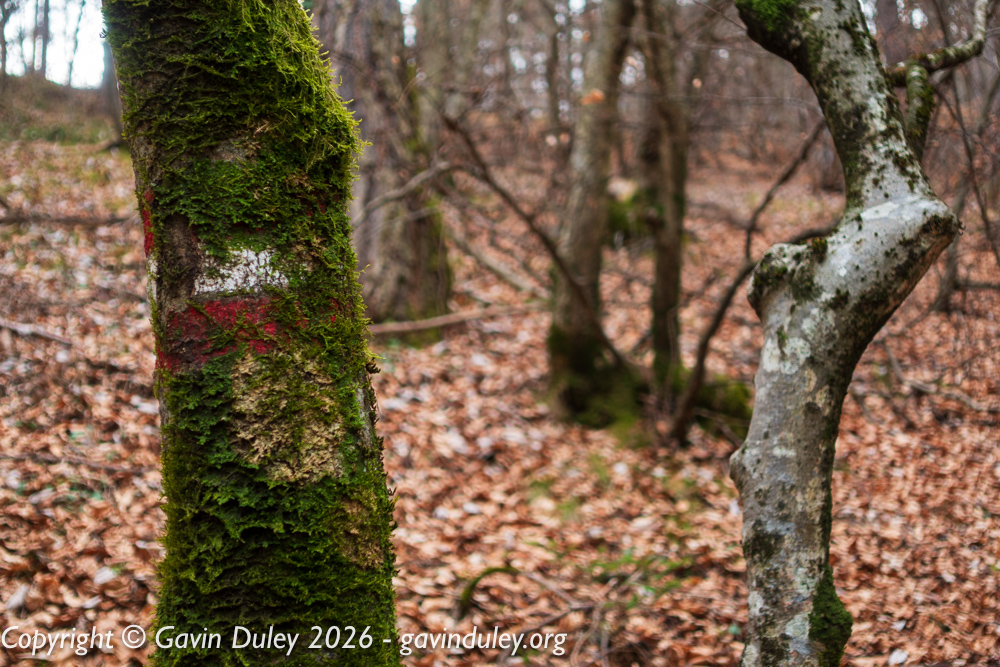
The woods near Caldaro Sony RX100 IV, 8.8-25.7mm Vario-Sonnar lens @ 24.3mm (66mm equiv), 1/125 at f/2.8, ISO 125, -0.7 ev
Last time, I said that birds were mostly seen heard but not seen; perhaps that’s just winter. This time: heard and — just — seen. The trick, I think, is to sit and wait.
Birds are finely attended to the sound of potential threats; a person crashing through the woods represents a threat that’s easily avoided. When you sit and wait, you fade into the background, registered less as a threat than as furniture. So, this time: blackbirds (Turdus merula) flitting on the edge of vision. A mash tit (Poecile palustris) patrolling his territory, black cup displayed proudly. Head, out of sight: song thrush (Turdus philomelos), robin (Erithacus rubecula), coal tit (Periparus ater), chiffchaff (Phylloscopus collybita), blue tit (Cyanistes caerulus), Cetti’s warbler (Cettia cetti).
So, rain lurking just over the horizon, 9°C, the ground scattered with last year’s dead leaves, but still unmistakably spring.
Hepatica nobilis, the woods near Caldaro Sony RX100 IV, 8.8-25.7mm Vario-Sonnar lens @ 25.7mm (70mm equiv), 1/80 at f/8, ISO 320, -0.7 ev
I often walk in the woods near my home; the walk is a chance to think through things and it calms the mind. Such walks through the woods are an obvious metaphor for a walk through internal landscapes, and the thoughts flowing through one’s mind can seem crystal clear enough to warrant noting down, either in the moment or later.
But one difficulty with nature writing is knowing where to begin. The obvious, immediate choice is to write from a position of supposed objectivity: this isn’t about me, or what I saw, or did, or thought, or felt; this is about the external world of nature as it is. One retreats behind a barrier of objectivity. The risk is of perceived arrogance: my perception is objective, perhaps yours isn’t. Or one can write from a more personal perspective: this isn’t a big claim to objective fact, this is what I saw, and heard, and thought, and felt. Here, the risk is again of perceived arrogance: in today’s parlance, one is ‘centring’ the experience, and the discussion of the experience, on oneself. By writing from your own voice, your own perspective, you are not writing from another perspective or another voice, and thus may be seen as dismissing or silencing other voices. (Yet a paradox: if you can’t write with your own voice, no one can, and everyone is silenced.) So, where to begin…?
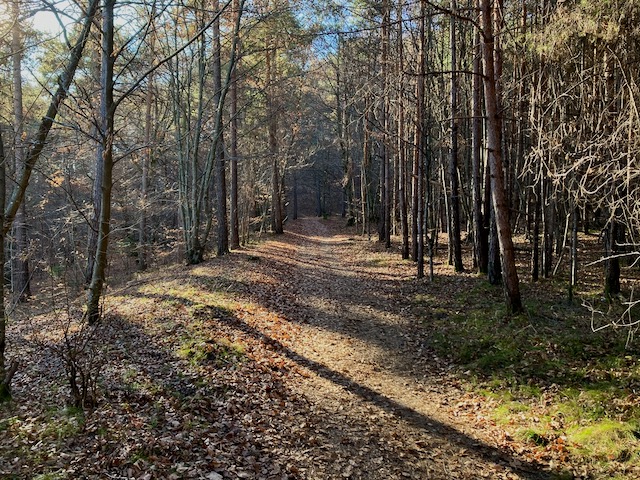
A path though the woods iPhone SE2, 26mm f/1.8 equivalent lens, 1/121 sec at ISO 50, -0.4 ev
I often walk in the woods near my home; the walk is a chance to think through things and it calms the mind. But one mustn’t confuse a walk in the woods with a walk through an internal landscape; the woods are too important for that, too vital, too firm in their actuality. To confuse the internal and external landscapes cheapens both. To prioritise the thoughts fighting for space in my head, or the crystal-clear thoughts that might flow as I walk, can mean being blind to the life of the woods around me. The woods in winter are quiet, particularly around town, but not empty. Deciduous trees appear dead, conifers alone still showing some signs of life. Concentration is needed to see beyond this. There are mosses, grasses, bracken, heathers, gorse, all still visibly holding on.
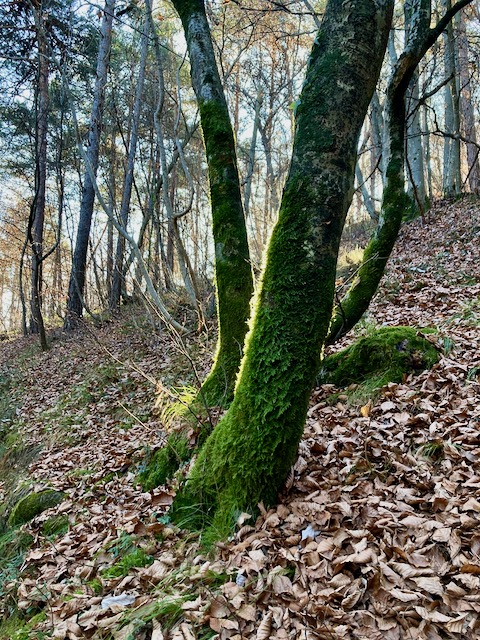
These small signs are, nonetheless, as artlessly beautiful as the last glow of the day reflected pinkly on the mountains, and just as shaped by the light. The low winter sun raking through the trees, picking out fallen leaves. Bracken, just catching the sun. Moss on a tree, backlit, appearing to glow from within.
Backlit iPhone SE2, 26mm f/1.8 equivalent lens, 1/76 sec at ISO 80, -0.5 ev
Wildlife here is mostly heard rather than seen, sometimes only an implied presence. There are bears in the hills, but they mostly don’t come so close to town; boars have also been sighted, introduced by hunters, but again mostly keep away from town. A reminder, though, that these woods are not necessarily as safe or as tame as they might first appear. Deer are more frequent, but mostly heard as a crash in the distance, retreating even when already out of sight. Sometimes I can catch a glimpse of a retreating white tail among the denser trees, but it’s rare to see more than that.
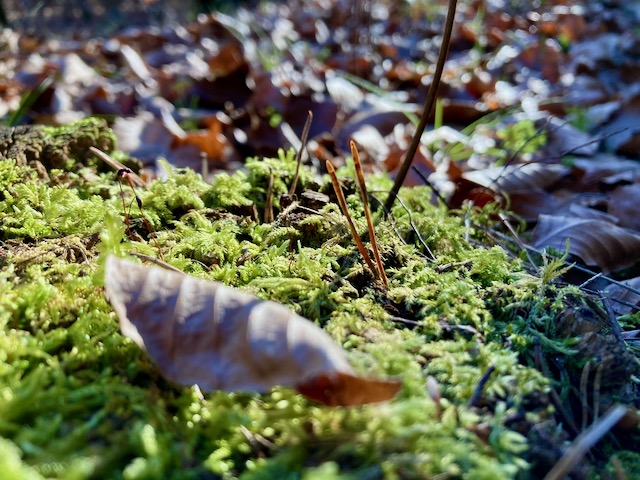
Moss, a scene in miniature (perhaps Ceratodon purpureus?) iPhone SE2, 26mm f/1.8 equivalent lens, 1/171 sec at ISO 20
Birds, however, are a more constant presence. I hear them whistling and chirping in the distance if I stop and am quiet for a few minutes. There is a view over the lake, and I often stop and sit there for a while. When I’m pushed for time, that’s my walk: I walk to the lookout, sit for a bit, then walk home. Often, if I wait, if I’m quiet, if there aren’t other walkers around, I’ll see some closer up: a finch, or a warbler, or a brambling, a treecreeper, or perhaps a woodpecker. Sometimes I might see a kite circling over the valley below, gliding on the thermals.
Today, though, an odd bird: booming like a bittern but quite different and more irregular; a chee-wup! or kee-op! call, slow to start, ending with an abrupt rifle snap. After a few minutes, these were replaced by the guttural aark of a pair of common ravens (Corvus corax) or hooded crows (Corvus cornix). In Australia, I’d think it was an eastern whipbird (Psophodes olivaceus), but I don’t think one of these has followed me here. A mystery, even so close to home? A reminder of one’s own ignorance? But the question shouldn’t be about me. A bird calling in the woods is more interesting than that; to reduce it to a personal mystery is to cheapen it.