I often walk in the woods near my home; the walk is a chance to think through things and it calms the mind. Such walks through the woods are an obvious metaphor for a walk through internal landscapes, and the thoughts flowing through one’s mind can seem crystal clear enough to warrant noting down, either in the moment or later.
But one difficulty with nature writing is knowing where to begin. The obvious, immediate choice is to write from a position of supposed objectivity: this isn’t about me, or what I saw, or did, or thought, or felt; this is about the external world of nature as it is. One retreats behind a barrier of objectivity. The risk is of perceived arrogance: my perception is objective, perhaps yours isn’t. Or one can write from a more personal perspective: this isn’t a big claim to objective fact, this is what I saw, and heard, and thought, and felt. Here, the risk is again of perceived arrogance: in today’s parlance, one is ‘centring’ the experience, and the discussion of the experience, on oneself. By writing from your own voice, your own perspective, you are not writing from another perspective or another voice, and thus may be seen as dismissing or silencing other voices. (Yet a paradox: if you can’t write with your own voice, no one can, and everyone is silenced.) So, where to begin…?
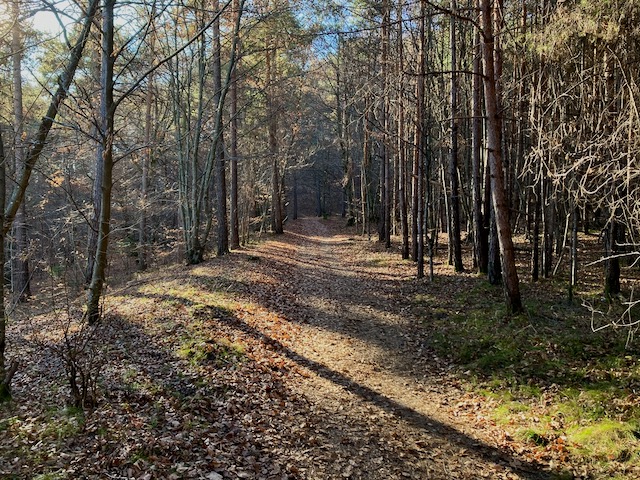
A path though the woods iPhone SE2, 26mm f/1.8 equivalent lens, 1/121 sec at ISO 50, -0.4 ev
I often walk in the woods near my home; the walk is a chance to think through things and it calms the mind. But one mustn’t confuse a walk in the woods with a walk through an internal landscape; the woods are too important for that, too vital, too firm in their actuality. To confuse the internal and external landscapes cheapens both. To prioritise the thoughts fighting for space in my head, or the crystal-clear thoughts that might flow as I walk, can mean being blind to the life of the woods around me. The woods in winter are quiet, particularly around town, but not empty. Deciduous trees appear dead, conifers alone still showing some signs of life. Concentration is needed to see beyond this. There are mosses, grasses, bracken, heathers, gorse, all still visibly holding on.
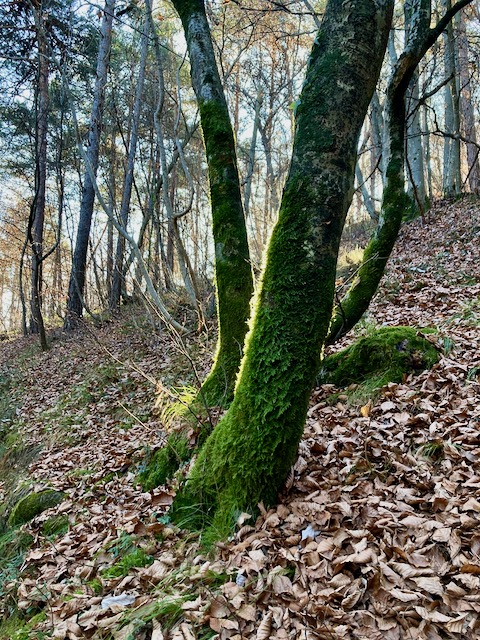
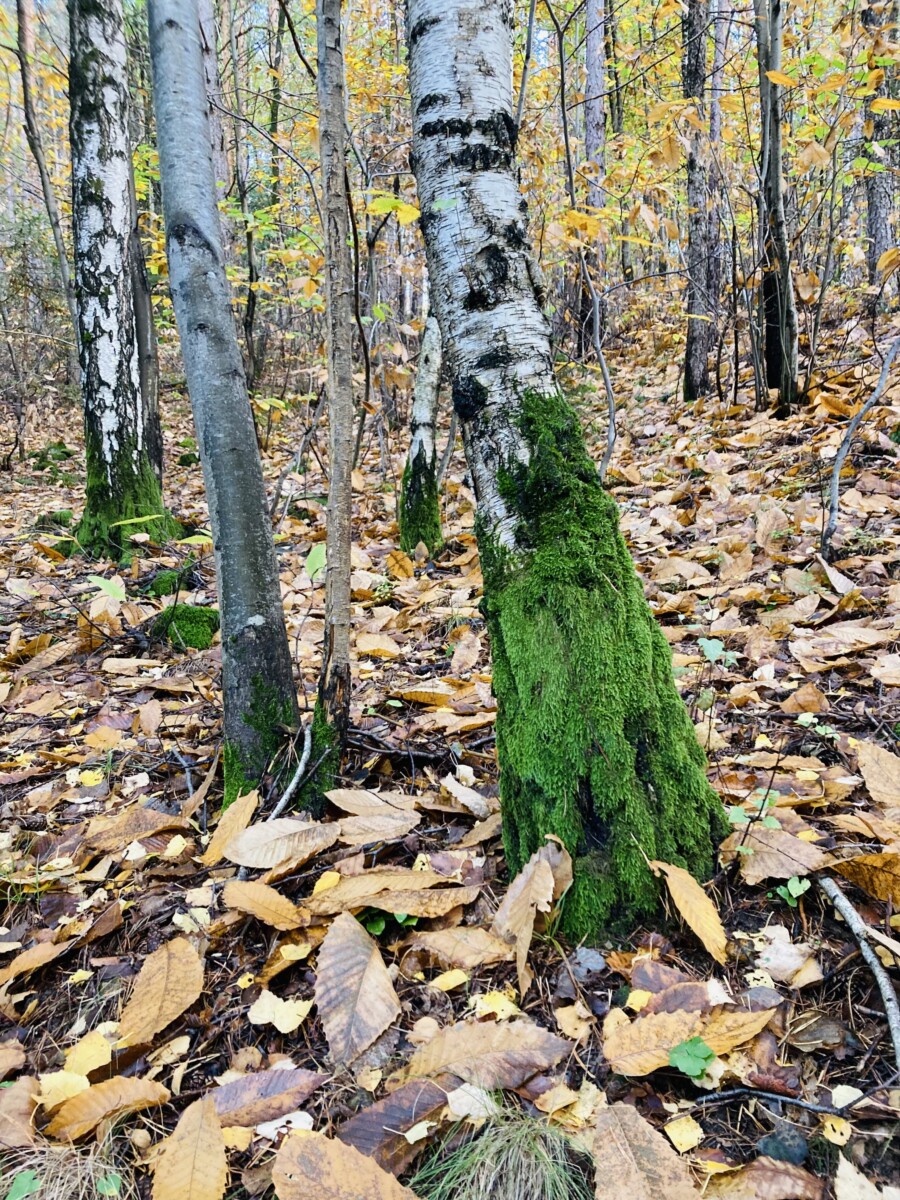
These small signs are, nonetheless, as artlessly beautiful as the last glow of the day reflected pinkly on the mountains, and just as shaped by the light. The low winter sun raking through the trees, picking out fallen leaves. Bracken, just catching the sun. Moss on a tree, backlit, appearing to glow from within.
Backlit iPhone SE2, 26mm f/1.8 equivalent lens, 1/76 sec at ISO 80, -0.5 ev
Wildlife here is mostly heard rather than seen, sometimes only an implied presence. There are bears in the hills, but they mostly don’t come so close to town; boars have also been sighted, introduced by hunters, but again mostly keep away from town. A reminder, though, that these woods are not necessarily as safe or as tame as they might first appear. Deer are more frequent, but mostly heard as a crash in the distance, retreating even when already out of sight. Sometimes I can catch a glimpse of a retreating white tail among the denser trees, but it’s rare to see more than that.
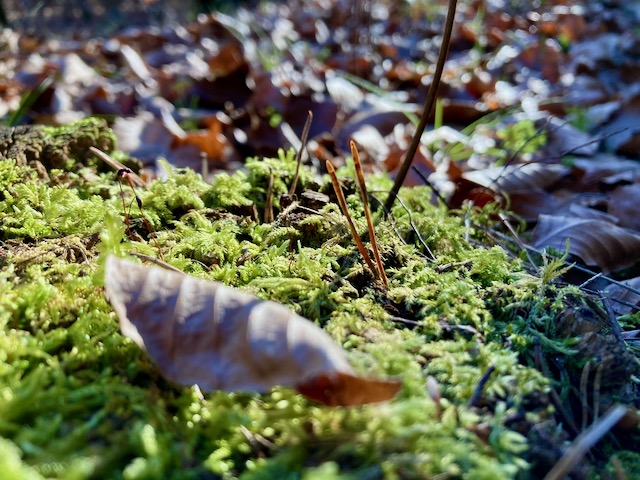
Moss, a scene in miniature (perhaps Ceratodon purpureus?) iPhone SE2, 26mm f/1.8 equivalent lens, 1/171 sec at ISO 20
Birds, however, are a more constant presence. I hear them whistling and chirping in the distance if I stop and am quiet for a few minutes. There is a view over the lake, and I often stop and sit there for a while. When I’m pushed for time, that’s my walk: I walk to the lookout, sit for a bit, then walk home. Often, if I wait, if I’m quiet, if there aren’t other walkers around, I’ll see some closer up: a finch, or a warbler, or a brambling, a treecreeper, or perhaps a woodpecker. Sometimes I might see a kite circling over the valley below, gliding on the thermals.
Today, though, an odd bird: booming like a bittern but quite different and more irregular; a chee-wup! or kee-op! call, slow to start, ending with an abrupt rifle snap. After a few minutes, these were replaced by the guttural aark of a pair of common ravens (Corvus corax) or hooded crows (Corvus cornix). In Australia, I’d think it was an eastern whipbird (Psophodes olivaceus), but I don’t think one of these has followed me here. A mystery, even so close to home? A reminder of one’s own ignorance? But the question shouldn’t be about me. A bird calling in the woods is more interesting than that; to reduce it to a personal mystery is to cheapen it.
One reason that Italian wines are a constant source of interest for wine enthusiasts1 is that, pretty much no matter how long you’ve been studying wine, you’ll always keep coming across new regions and new grapes you’ve not heard of previously. This can happen when visiting a supermarket, or when travelling — particularly in regions not known for their wine.
For me, at least, Lombardy is such a region. I’m not sure why. It does grow quite a bit of wine, and some regions, such as Valtellina, are not particularly obscure. I guess it lacks any ‘big names’ — there is no village with the stature or recognition of Barolo or Brunello here. But — thankfully — that’s not all there is to wine.
I’ve been lucky enough to visit Brescia and Bergamo a number of times, and have enjoyed finding out about the wines grown in their respective regions. With the exception of Franciacorta sparkling wine, which I won’t cover here, neither are terribly well known outside the region, but both are — to my mind — well worth exploring. I’ll quickly run through a few of the regions I’ve come across so far, and give some details of the wines I’ve tried.
Brescia
Pusterla vineyard, Brescia.
Brescia’s vineyards sit between the mountains and the plain, with Alpine breezes on one side and warm Po Valley sunshine on the other. These are the same hills that give the world Franciacorta sparkling wine, but the still wines deserve a little attention too. Curtefranca DOC covers much of the same ground, and the soils are a patchwork — limestone and marl here, glacial debris there — all of which helps keep the wines lively. The reds lean on Bordeaux grapes like ‘Cabernet Sauvignon’ and ‘Merlot’, often with an Italian twist from ‘Nebbiolo’ or ‘Barbera’, while the whites are typically ‘Chardonnay’ and ‘Pinot bianco’.
One curiosity worth mentioning is the Pusterla vineyard, Europe’s largest urban vineyard, which clings to the slopes just below Brescia’s castle. This sun-exposed hillside is the top of a stratified limestone spur, and is known for its marl and flint nodules, also called medolo. First planted in 1037 by the royal monastery of Santa Giulia, the site has undergone many changes of ownership over the centuries and has been abandoned at various points. Despite its difficult history, it is now thriving again under the care of Emanuele Rabotti (Monte Rossa winery, Franciacorta). This unique vineyard is home to a unique grape — ‘Invernenga’, a rare late-ripening white with unusually thick, polyphenol-rich 🦜 skins. Once grown mostly for passito, it now makes dry whites with a pleasantly savoury edge — a little slice of vineyard history hidden in the city.
Nike, Brescia Roman Temple
If you follow the vines south, you come to Montenetto di Brescia IGT, centred on Monte Netto, a clay-rich rise out of the plain. Viticulture here likely started with the Romans, once the marshy soils had been drained, but the first definite reference to wine growing in the region was in the sixteenth century, with Le dieci giornate della vera agricoltura e dei piaceri della villa by Agostino Gallo, Renaissance agronomist, which mentions ‘Marzemino’ in particular, now grown as Capriano del Colle DOC Marzemino. The IGT rules are broad, but the standouts are ‘Trebbiano’ in its various guises and ‘Marzemino’, alongside ‘Barbera’, ‘Sangiovese’, ‘Merlot’, and ‘Chardonnay’. The whites tend to be floral and lightly fruity, while the reds are fresh and harmonious — the sort of bottles made for local trattoria cooking rather than long-term cellaring.
Curtefranca DOC
2020 Ferghettina Curtefranca Colour: Medium(+) purple Nose: medium(-) intensity, tertiary, developing. Redcurrant, cassis, strawberry, pomegranate, cherry syrup. Blueberry. Mushroom, barnyard, forest floor, cough syrup. Cedar, sweet spice. Palate: dry, medium(+) acidity, medium tannins, medium alcohol (13,5%), medium bodied. Medium length finish, medium intensity. Redcurrant, cassis, strawberry, pomegranate, cherry syrup. Blueberry. Mushroom, barnyard, forest floor, cough syrup. Cedar, sweet spice. Conclusions: very good. Can drink now, but suited to further ageing. Seal: cork Blend: 50% Cabernet Sauvignon, 30% Merlot, 10% Nebbiolo, 10% Barbera – I am not sure if this varies somewhat from year to year Tasted 17/2/2023
2022 Ferghettina Curtefranca Colour: medium (+) purple Nose: medium(-) intensity, secondary, youthful. Red and black plum, blackcurrant, fruiti di bosco jam, blueberry. Smoke, bergamot. Charred oak. Palate: dry, medium acidity, medium tannins, medium alcohol (13,5%), medium bodied. Medium intensity, medium length finish. Red and black plum, blackcurrant, fruiti di bosco jam, blueberry. Smoke, bergamot. Charred oak. Conclusions: good — but not as interesting as I remember from last time. P&P (pop&pour), not decanted. Half bottle at Ma!Osteria Brescia Tasted 23/8/2025
2019 Ca’ del Bosco ‘Corte del Lupo’ Curtefranca Colour: medium(+) ruby Nose: medium intensity, secondary, youthful. Pomegranate (esp. on first opening), red cherry, blueberry. Strawberries stewed in balsamic vinegar. Cedar, cinnamon, maybe vanilla. Dried herbs. Touch of earthiness. Pomegranate seemed most dominant when first opened, but blueberry came to the fore with air. Palate: dry, medium(+) acidity, medium(+) tannins, medium alcohol (13%), medium bodied. Medium intensity, medium(+) length finish. Pomegranate (esp. on first opening), red cherry, blueberry. Strawberries stewed in balsamic vinegar. Cedar, cinnamon, maybe vanilla. Dried herbs. Touch of earthiness. Conclusions: very good. Quite lithe and elegant, refined but with an earthy savouriness. Can drink now, but likely suited to further ageing. Just as good on day 2, after being left open overnight. Seal: natural cork 49% Merlot, 31% Cabernet Sauvignon, 9% Cabernet Franc, 11% Carménère Tasted 15/4/2023
2018 Coop Vitivinicola Cellatica Gussago Curtefranca Rosso Colour: medium garnet Nose: medium(+) intensity, tertiary, developing. Red and black plum, plum jam, bramble, cassis. Tamarillo. Black pepper, tomato stem. Some savoury character and maybe the start of forest floor character. Palate: dry, medium acidity, medium(+) tannins, medium alcohol (13%), medium bodied. Medium intensity, short finish. Red and black plum, plum jam, bramble, cassis. Tamarillo. Black pepper, tomato stem. Some savoury character and maybe the start of forest floor character. Conclusions: good — let down slightly by the short finish. Can drink now, but suited to further ageing. P&P (pop&pour), not decanted. Seal: DIAM2 cork Merlot, Cabernet Franc, Cabernet Sauvignon. Tasted 21/5/2024
2015 Ricci Curbastro ‘Vigna Santella del Gröm’ Curtefranca Colour: medium(+) ruby Nose: medium(+) intensity, secondary, youthful. Strawberry, redcurrant, red and black plum. Blackcurrant jelly? Strawberry jam? Blueberry. White pepper, cedar, nutmeg, bread dough. Smoke and maybe bergamot. Palate: dry, medium(+) tannins (fine grained, silky, but drying), medium acidity, medium alcohol (12,5%), medium(-) bodied. Strawberry, redcurrant, red and black plum. Blackcurrant jelly? Blueberry. White pepper, cedar, nutmeg. Cough syrup/medicinal. Bergamot? Conclusions: very good. Can drink now, but suited to further ageing. Quite fresh and young at eight years of age. Relatively light and dominated by red fruit. The tannins and acidity work well with food. Very drinkable. Blend of Cabernet Franc, Merlot, Cabernet Sauvignon, Carmenere, and Barbera. Tasted 7/11/2023
2021 Ferghettina Curtefranca Bianco Colour: pale lemon-green Nose: medium intensity, secondary, youthful. Green apple, lemon, lemon peel. Pineapple. Nectarine. Honey. White flowers. Lees character: biscuit and cream. Palate: dry, medium(+) acidity, medium alcohol (12,5%), medium(-) bodied. Medium intensity, medium long finish. Green apple, lemon, lemon peel. Pineapple. Nectarine. Honey. White flowers. Lees character: biscuit and cream. Green apple very dominant when first opened, but improves with air. Conclusions: good. Can drink now, but suited to further ageing. Pretty good value at €9.50! Seal: technical cork. DAY2: left in fridge overnight. Green apple and nectarine still prominent, but now maybe with wet stone and saline notes. 80% Chardonnay 20% Pinot Blanc (Pinot Bianco) Tasted 6/6/2023
Montenetto di Brescia IGT
2021 Barone Pizzini Montenetto di Brescia IGT Colour: pale lemon yellow Nose: medium intensity, secondary, youthful. Lemon, lemon peel. Apple — Granny Smith, Russet. White flowers. Cream? Palate: dry, high acidity, medium alcohol (13%), medium bodied. Medium intensity, medium length finish. Lemon, lemon peel. Apple — Granny Smith, Russet. White flowers. Cream? Conclusions: good. Can drink now, but suited to further ageing. P&P (pop&pour), not decanted. Seal: DIAM5 technical cork Blend of Trebbiano & Chardonnay Tasted 18/8/2024
Vino di Tavola (Pusterla vineyard, Brescia)
2020 Monte Rossa Pusterla Vino Bianco Colour: medium gold Nose: medium intensity, secondary, youthful. Dried apricot, lemon, lemon peel, underripe pineapple. Heritage apples. Honeyed. Almonds? Ginger? Wet stone, saline. Hay. Palate: dry, medium(+) acidity, medium alcohol (12%), medium(-) bodied. Dried apricot, lemon, lemon peel, underripe pineapple, kiwifruit. Heritage apples. Honeyed. Ginger? Wet stone, saline. Conclusions: very good. I wasn’t expecting much from this for whatever reason — I worried it might just be a novelty — but it’s a genuinely interesting, complex, and unusual wine. Hard to pin down the flavours and aromas precisely. 100% late harvest Invernenga, an autochthonous grape cultivar from Brescia, Lombardy, Italy, and grown in a vineyard within the castle grounds of Brescia — said to be the largest urban vineyard in Europe. P&P (pop&pour), not decanted. Seal: screwcap. Tasted 2/5/2024
Bergamo
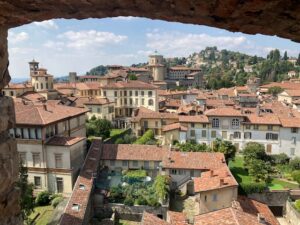
Bergamo and the Bergamo hills, from la Torre Civica
Bergamo also boasts a long relationship with the vine. The Romans planted vineyards around Scanzorosciate, and the region was well regarded enough for its wine that the village of San Lorenzo had a temple to Bacchus. The Lombard invasions set viticulture back, but monasteries kept the culture of the vines alive, and by the fifteenth century Bergamo’s wines were pouring into Milan. Like elsewhere, phylloxera caused devastation, but early twentieth-century replantings set the stage for the region’s modern revival.
The creation of the Valcalepio DOC in 1976 was a key moment for the modern history of wine growing in Bergamo. The DOC covers the hills between the Orobic Alps, Lake Iseo, and Monte Canto. The reds are usually Bordeaux blends — a bold choice at the time — ‘Merlot’ with ‘Cabernet Sauvignon’, occasionally scented with the local ‘Moscato di Scanzo’. The whites draw on ‘Chardonnay’, ‘Pinot bianco’, and ‘Pinot grigio’. They’re good food wines, often with a savoury edge that suits the region’s hearty cooking. In 1993, a Valcalepio rosso riserva DOC was created, allowing for the production of longer-aged wines. Also worth noting: a passito made from ‘Moscato di Scanzo’, made locally since at least 1347, is said to have been a favourite of Catherine the Great. (I’ve yet to try this myself… even in Italy, the wines from here can be a bit tricky to find!)
Terre del Colleoni DOC, a newer denomination (2011), takes in a broader cast of grapes: ‘Schiava’, ‘Marzemino’, ‘Franconia’, and the rare ‘Incrocio Terzi’, along with ‘Manzoni bianco’. These wines tend to be fruit-forward and easy to enjoy, from pale, cherry-coloured reds to aromatic whites with citrus and stone-fruit lift. To my mind, it’s when you add in the tiny appellations such as Moscato di Scanzo DOCG — a sweet red made from the native grape of the same name — that Bergamo’s picture comes fully into focus, making it far more interesting than its low profile might suggest.
And that, really, is the point: neither Brescia nor Bergamo may be household names in the wine world, but both reward a little curiosity — and a bottle or two shared2 at the table.
Valcalepio DOC
2020 Locatelli Caffi Valcalepio Colour: medium (-) purple Nose: medium (-) intensity, secondary, youthful. Cassis, red plum, red cherry, pomegranate. Cola. Blackcurrant leaf, maybe green capsicum? Sweet spice. Earthy, forest floor Palate: dry, medium acidity, medium tannins, medium alcohol)13%), medium bodied. Medium (-) intensity , medium(-) length finish. Cassis, red plum, red cherry, pomegranate. Cola. Blackcurrant leaf, maybe green capsicum? Sweet spice. Earthy, forest floor Conclusions: good. Can drink now but suited to further ageing Seal cork. Merlot – Cabernet blend. Notes from half bottle at Da Ornella, Bergamo Tasted 2/6/2023
2023 Locatelli Caffi Valcalepio Colour: medium ruby Nose: medium(-) intensity, secondary, youthful. Red plum, blackcurrant. Strawberry, redcurrant. Gooseberry, green capsicum. Sweet spice. Palate: dry, medium(-) tannins, medium alcohol (13,5%), medium acidity, medium bodied. Red plum, blackcurrant. redcurrant. Gooseberry, green capsicum. Sweet spice. Conclusions: good – just a little short on the palate. Can drink now, but suited to further ageing. P&P (pop&pour), not decanted. Half bottle at Trattoria da Ornella, Bergamo. Tasted 26/8/2025
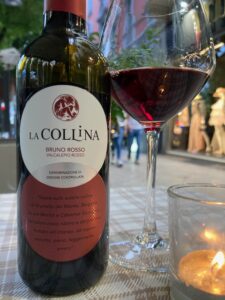
2018 La Collina ‘Bruno’ Valcalepio Rosso Colour: medium(-) ruby Nose: medium intensity, secondary, youthful. Fruits of the forest: strawberry, blueberries, blackberry, blackcurrant, redcurrant. Hint of forest floor? With air, dried orange peel. Vanilla, cedar. Palate: dry, medium(-) acidity, medium(-) tannins (v.smooth & fine grained), medium alcohol (13,5%), medium(-) bodied. Medium intensity, medium length finish. Fruits of the forest: strawberry, blueberries, blackberry, blackcurrant, redcurrant. Hint of forest floor? With air, dried orange peel. Vanilla, cedar. Conclusions: very good. Can drink now, but suited to further ageing. Seal: cork Notes from half bottle at La Ciotola Restaurant, Bergamo Tasted 3/6/2023
2018 Tenuta Castello di Grumello Valcalepio Colour: medium ruby Nose: medium intensity, secondary, youthful. Red cherry, red and black plum, cassis. Juniper berry. Dried red fruit leather, strawberry. Rosemary? Cedar, bitter cocoa. Earthy and leathery in the empty glass. Palate: dry, medium(-) tannins, medium(+) acidity, high alcohol (14%), medium bodied. Medium intensity, medium length finish. Red cherry, red and black plum, cassis. Juniper berry. Dried red fruit leather, strawberry. Tamarillo, cranberry. Rosemary? Cedar, bitter cocoa. Earthy and leathery. Conclusions: very good. Can drink now, but suited to further ageing. Seal: DIAM5 cork Merlot and Cabernet Sauvignon. Tasted 13/11/2023
Terre del Colleoni
2021 Villa Domizia Punto ‘Uno Manzoni’ Terre del Colleoni Bianco Passionfruit, pineapple, apricot, lemon curd. Lots of fresh tropical fruit backed up by fresh citrusy acidity. Wet stones. Quite fresh and refreshing. No detailed notes since by the glass at a restaurant. Very good! By the glass at La Bottega Del Gusto, Bergamo Tasted 3/6/2023
and finally… a Franciacorta
NV Facchetti Franciacorta Franciacorta Nature Colour: pale lemon yellow Nose: medium(-) intensity, youthful, secondary. Lemon, lemon peel, green apple. Hint of beeswax and lanolin. Cream. Palate: medium(+) acidity, medium alcohol, medium bodied, delicate mousse. Medium intensity, medium length finish. Lemon, lemon peel, green apple. Hint of beeswax and lanolin. Cream. Wet stone, hint of salinity. Conclusions: very good! Can drink now, but likely suited to further ageing. By the glass. Tasted 23/8/2025
I don’t really like the term ‘wine enthusiast’, perhaps due to a hazy memory of the joke about axe wielding maniacs preferring to be called axe enthusiasts. Nothing quite captures what I want to say as well as the French phrase ‘amateur de vin’. Unfortunately, the word amateur has become rather devalued in English — it is rather sad that doing something simply for the love of it is seen as a negative! ↩︎
Well, I’ll try. Sharing is difficult, especially with good wine. ↩︎
Winter morning, Girlan, Eppan an der Weinstraße, Südtirol, Italy iPhone SE2, built-in 3.99 mm lens, 1/287 sec, f/1.8, ISO 20.
A cold but bright winter morning. Light snow overnight, clearing before dawn. Frost in the air. Just after 8 am, but the sun is only just hitting the mountains with warm light. Bozen, in the valley below, is still shrouded with fog.
St Michael Eppan iPhone SE2, built-in 3.99 mm lens, 1/800 sec, f/1.8, ISO 20.
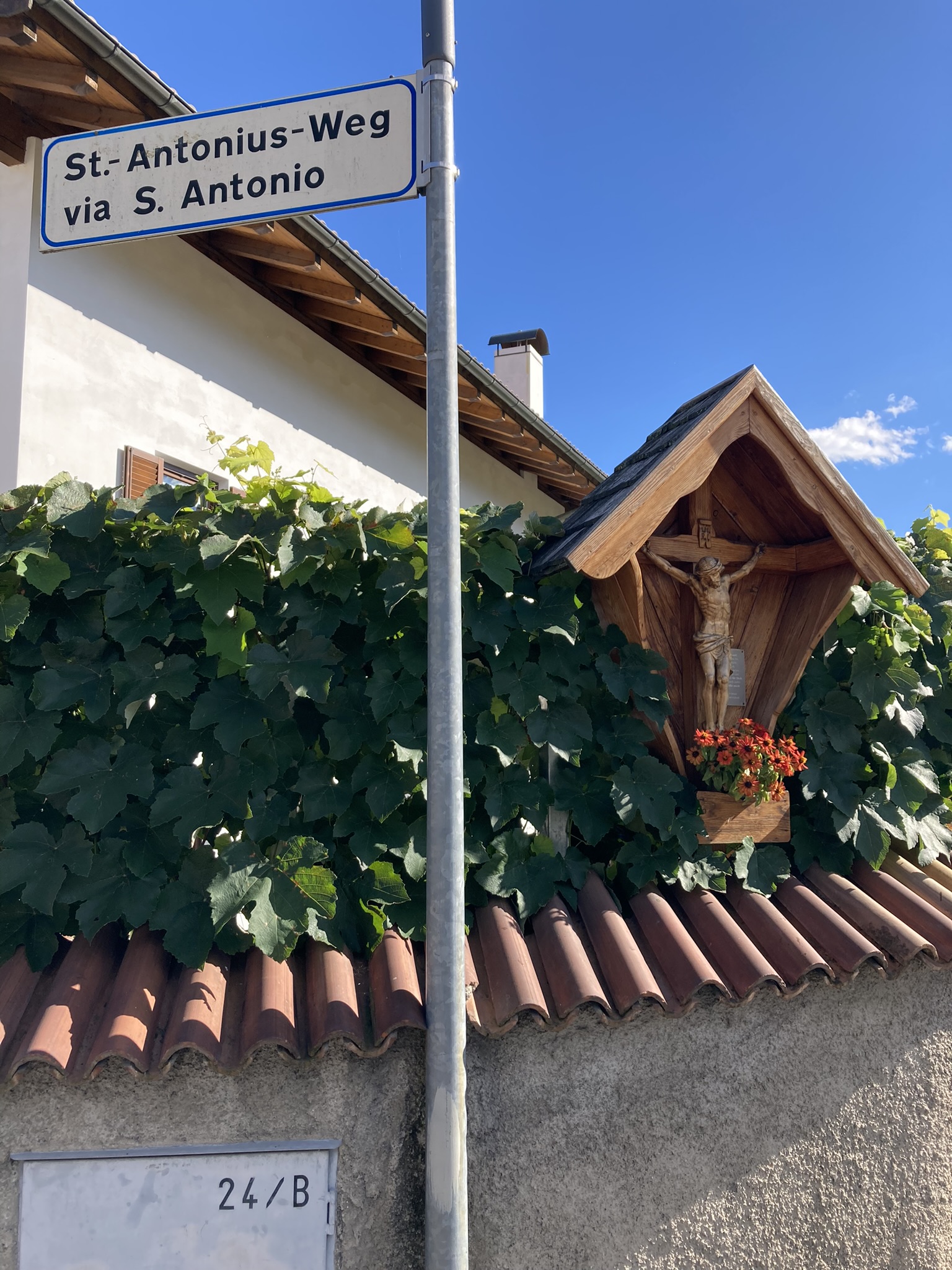
St Anthony’s Way, Autumn. Two tiny terriers snarl ferociously at me when I stop to take the photo, defending their territory against all-comers. It’s good there’s a sturdy fence between us, or they’d tear me to shreds. Or I’d tred on them without noticing.
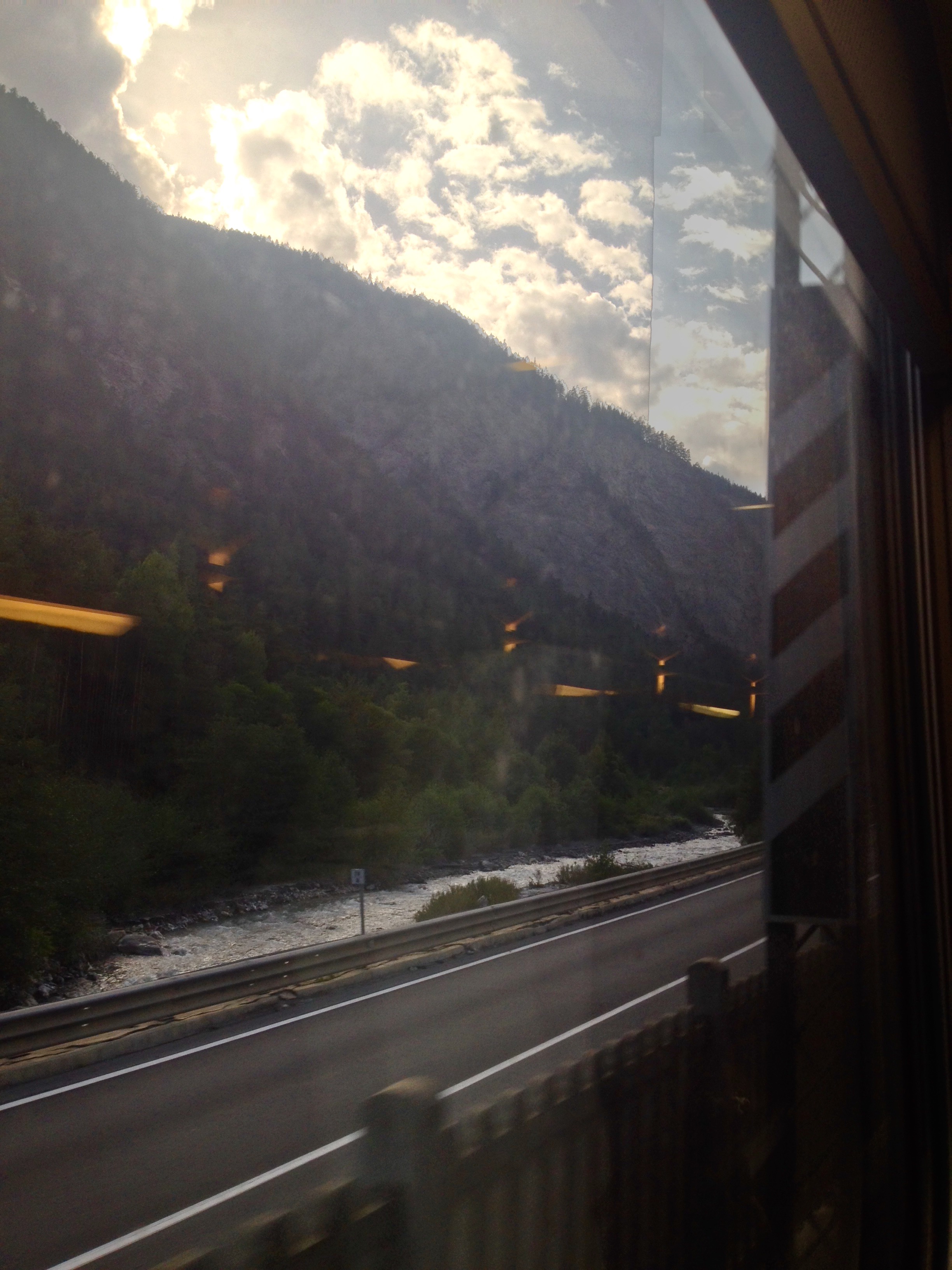
A train through (and under) the mountains. Brief glimpses of alpine streams, cold and fast flowing. A person walking through a small village. What is the connection that you could possibly have with them in this brief moment — if any?
Later, glimpses of limestone cliffs amongst oak trees. Vegetation so luxuriant it’s almost tropical. Lakes and steep drop-offs to gullies.